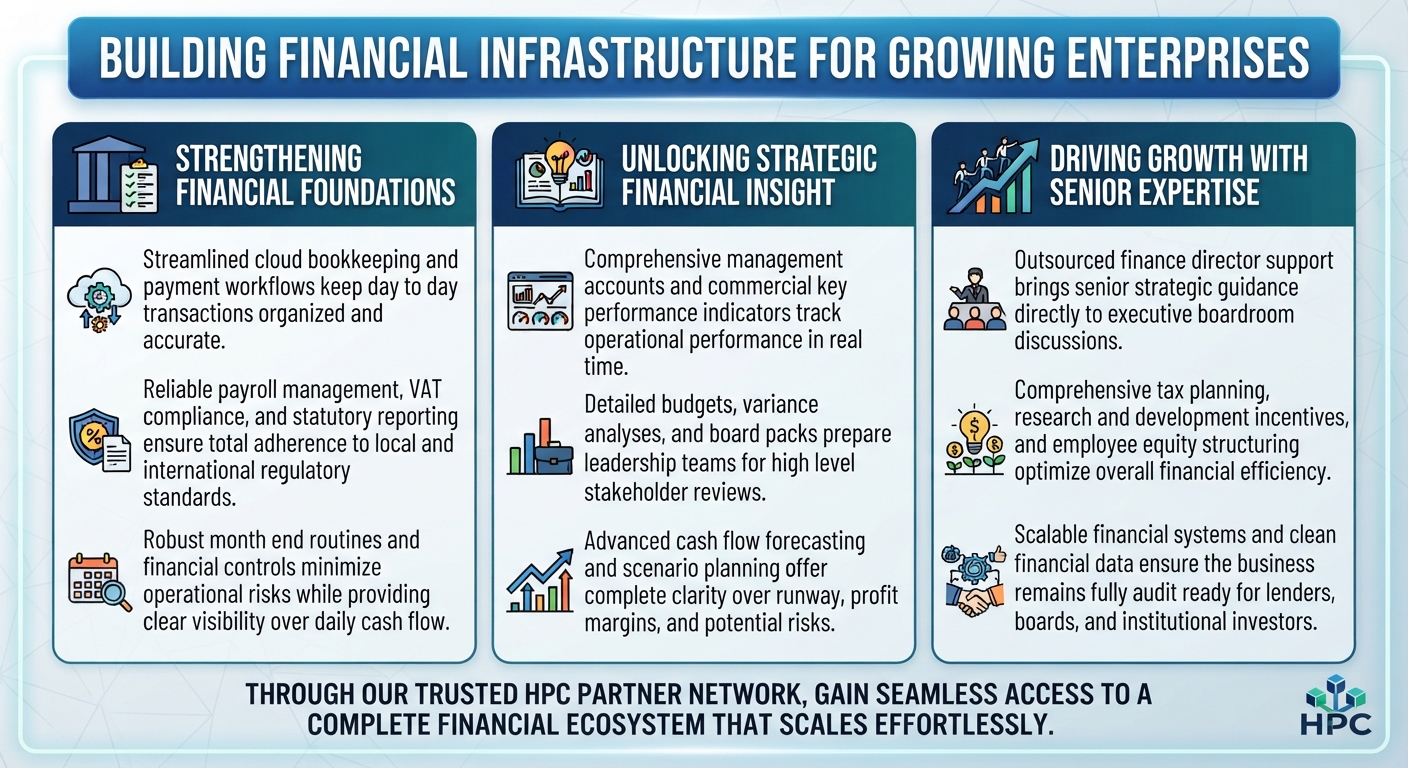
Growing businesses quickly outgrow basic bookkeeping as operations become more complex, requiring a structured and dependable approach to financial management. Through our trusted HPC partner network, modern companies gain seamless access to a complete financial ecosystem that scales effortlessly without the friction of switching providers or rebuilding internal departments.
Strengthening Financial Foundations
Establishing dependable back office processes is the essential first step toward long term stability and compliance.
Streamlined cloud bookkeeping and payment workflows keep day to day transactions organized and accurate.
Reliable payroll management, VAT compliance, and statutory reporting ensure total adherence to local and international regulatory standards.
Robust month end routines and financial controls minimize operational risks while providing clear visibility over daily cash flow.
Unlocking Strategic Financial Insight
Moving beyond basic accounting requires turning raw numbers into actionable commercial intelligence for better decision making.
Comprehensive management accounts and commercial key performance indicators track operational performance in real time.
Detailed budgets, variance analyses, and board packs prepare leadership teams for high level stakeholder reviews.
Advanced cash flow forecasting and scenario planning offer complete clarity over runway, profit margins, and potential risks.
Driving Growth With Senior Expertise
Accessing high level financial leadership allows growing organizations to prepare effectively for fundraising, strategic investments, and corporate exits.
Outsourced finance director support brings senior strategic guidance directly to executive boardroom discussions.
Comprehensive tax planning, research and development incentives, and employee equity structuring optimize overall financial efficiency.
Scalable financial systems and clean financial data ensure the business remains fully audit ready for lenders, boards, and institutional investors.
Frequently Asked Questions (FAQs)
1. How do Thailand businesses build strong financial foundations for growth?
Thailand businesses establish dependable back office processes through cloud bookkeeping, automated payment workflows, and reliable VAT compliance.
2. What cloud bookkeeping tools are utilized for Thailand companies?
Modern cloud bookkeeping systems keep day-to-day transactions organized, accurate, and accessible for Thailand financial controllers.
3. How is payroll and statutory compliance managed for Thailand enterprises?
Reliable payroll management and statutory reporting ensure total adherence to local regulatory standards across Thailand.
4. What financial controls protect cash flow for Thailand firms?
Robust month end routines and internal financial controls minimize operational risks while providing complete visibility over daily cash flow in Thailand.
5. How do Thailand businesses transition from basic accounting to strategic insight?
Growing companies transform raw numbers into actionable commercial intelligence through detailed management accounts and commercial key performance indicators.
6. What reporting packages prepare Thailand leadership teams for board reviews?
Comprehensive management accounts, variance analyses, and tailored board packs prepare leadership teams for high level stakeholder reviews in Thailand.
7. How does cash flow forecasting benefit Thailand scale-ups?
Advanced cash flow forecasting and scenario planning offer complete clarity over runway, profit margins, and potential operational risks for Thailand businesses.
8. When should a Thailand business consider outsourced finance director support?
As operational complexity increases, Thailand companies can bring senior strategic guidance directly to executive boardroom discussions through outsourced finance director services.
9. How do tax planning services assist Thailand organizations?
Comprehensive tax planning, research and development incentives, and employee equity structuring help optimize overall financial efficiency for Thailand firms.
10. What ensures a Thailand company remains audit ready for investors?
Scalable financial systems and clean financial data ensure businesses remain fully audit ready for lenders, boards, and institutional investors in Thailand.
11. How does the HPC partner network support Thailand enterprises?
Our trusted HPC partner network grants growing Thailand companies seamless access to a complete financial ecosystem that scales without the friction of switching providers.
12. Can Thailand startups scale their finance functions without rebuilding departments?
Yes, businesses in Thailand can add resource, reporting, and specialist advice without rebuilding their finance function or moving between providers.
13. How do management accounts improve decision making for Thailand executives?
Management accounts track operational performance in real time, allowing Thailand decision makers to base choices on accurate, up-to-date data.
14. What support is available for Thailand businesses preparing for fundraising?
Outsourced finance director support helps Thailand businesses prepare effectively for fundraising, strategic investments, and corporate exits.
15. How are VAT and tax obligations handled for Thailand corporations?
Statutory compliance, VAT management, and rigorous month-end controls protect Thailand businesses from regulatory penalties.
16. Why do growing Thailand companies outgrow basic bookkeeping support?
As headcount, funding requirements, and operational complexity increase, basic accounting becomes insufficient, requiring a structured financial infrastructure in Thailand.
17. How do payment workflows improve efficiency for Thailand businesses?
Streamlined cloud payment workflows keep day-to-day transactions organized and minimize manual administrative effort for Thailand finance teams.
18. What metrics do commercial key performance indicators track for Thailand firms?
19. How do variance analyses assist Thailand financial management?
Variance analyses compare budgeted expectations against actual financial outcomes, enabling Thailand leaders to address discrepancies quickly.
20. What role do employee equity structures play for Thailand scale-ups?
Employee equity structuring helps Thailand companies attract and retain top-tier talent while aligning staff incentives with long-term corporate growth.
21. How do streamlined financial systems benefit Thailand lenders and investors?
Clean data and dependable financial reporting provide Thailand lenders and institutional investors with the transparency required to execute transactions with confidence.
22. Can international Thailand businesses access cross-border financial advisory?
Yes, our HPC partner network provides scalable financial support tailored to the international operational needs of Thailand companies.
23. What is the advantage of using a single relationship for Thailand financial services?
Thailand businesses avoid handover gaps by working with one connected team that evolves from back-office bookkeeping to board-level financial leadership.
24. How do month-end controls reduce financial risk for Thailand organizations?
25. How do research and development incentives support Thailand innovators?
R&D tax planning and incentives provide critical non-dilutive capital injection to support innovation and technical development within Thailand enterprises.
26. What strategic guidance do outsourced finance directors provide to Thailand firms?
Outsourced finance directors guide high-level capital allocation, budgeting strategy, and financial risk management for Thailand executive teams.
27. How does scenario planning protect Thailand businesses from market volatility?
Scenario planning models various economic outcomes, allowing Thailand decision-makers to stress-test their business models against potential market downturns.
28. What makes financial data scalable for expanding Thailand enterprises?
Scalable financial architectures utilize automated cloud tools and clean data structures that expand seamlessly as Thailand companies increase their headcount.
29. How do board packs assist corporate governance in Thailand?
Structured board packs deliver clear financial summaries and strategic insights, empowering board members in Thailand to govern effectively.
30. How do businesses in Thailand manage payroll complexity during rapid expansion?
Scalable payroll management systems handle growing headcounts and local statutory requirements effortlessly for Thailand employers.
31. What commercial challenges do Thailand decision-makers face during scaling?
Decision-makers often struggle with financial visibility, cash burn tracking, and complex reporting, which structured financial infrastructure resolves.
32. How do automated payment workflows save time for Thailand finance teams?
Automated workflows reduce manual invoice processing time and minimize human error in financial transactions across Thailand.
33. Why is real-time financial tracking critical for Thailand scale-ups?
34. How does the HPC partner network streamline operations for Thailand companies?
The network consolidates bookkeeping, management accounting, tax planning, and fractional FD services into one unified relationship for Thailand businesses.
35. What financial reports are essential for Thailand business review meetings?
Essential reports include profit and loss statements, balance sheets, cash flow forecasts, and customized commercial KPI dashboards tailored for Thailand firms.
36. How do Thailand enterprises prepare for corporate exits or acquisitions?
Comprehensive financial due diligence readiness, clean historical records, and senior advisory help Thailand companies maximize value during exit processes.
37. What steps do Thailand businesses take to upgrade their financial operations?
Companies evaluate their current reporting gaps and integrate advanced cloud tools and senior advisory support through our HPC partner network.
38. How do statutory reporting requirements impact Thailand companies?
Meeting strict statutory deadlines ensures legal compliance and builds trust with regulatory authorities across Thailand.
39. What financial insights help Thailand firms optimize their profit margins?
Detailed variance analysis and margin reporting identify operational inefficiencies and high-cost areas within Thailand business models.
40. How do fractional finance directors bridge talent gaps in Thailand?
Fractional FDs provide high-level strategic expertise without the overhead cost of hiring a full-time executive in Thailand.
41. How does clean financial data accelerate fundraising for Thailand ventures?
Investors in Thailand favor companies that present organized financial models, audited accounts, and clear growth metrics.
42. What role do cloud platforms play in modern Thailand accounting?
Cloud platforms enable remote collaboration, real-time data synchronization, and automated bank feeds for Thailand finance teams.
43. How do budgets assist resource allocation in Thailand organizations?
Structured budgets establish spending guardrails, ensuring that Thailand teams align capital allocation with primary strategic milestones.
44. Why do expanding Thailand firms need specialized tax advice?
Specialized tax advice ensures compliance while capturing available reliefs, R&D credits, and structuring incentives unique to Thailand jurisdictions.
45. How does risk management factor into financial strategy for Thailand enterprises?
Risk management frameworks evaluate cash runway stability, credit exposure, and tax liabilities to protect Thailand corporate assets.
46. What distinguishes basic bookkeeping from strategic financial management in Thailand?
Basic bookkeeping records historical transactions, whereas strategic financial management uses forward-looking forecasting and commercial KPIs to guide Thailand growth.
47. How do Thailand leadership teams track performance against strategic goals?
Leadership teams use customized management accounts and variance reports to measure actual execution against projected milestones in Thailand.
48. How do scalable financial systems accommodate multiple offices or entities in Thailand?
Unified cloud financial platforms consolidate data across multiple operating units or regional branches into a single reporting view for Thailand headquarters.
49. What support do Thailand companies receive during complex financial audits?
Expert guidance from our HPC partner network ensures all financial records, tax filings, and controls are audit-ready for Thailand regulators.
50. How can Thailand business leaders begin upgrading their finance function?
Leaders can outline their company growth objectives and connect with our HPC partner network to build a tailored financial infrastructure.